
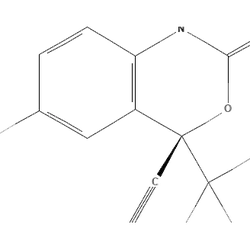
Efavirenz Stats & Data
Clc1ccc2NC(=O)OC(C#CC3CC3)(C(F)(F)F)c2c1XPOQHMRABVBWPR-ZDUSSCGKSA-NPharmacology
DrugBankDescription
Efavirenz (brand names Sustiva® and Stocrin®) is a non-nucleoside reverse transcriptase inhibitor (NNRTI) and is used as part of highly active antiretroviral therapy (HAART) for the treatment of a human immunodeficiency virus (HIV) type 1. For HIV infection that has not previously been treated, efavirenz and lamivudine in combination with zidovudine or tenofovir is the preferred NNRTI-based regimen. Efavirenz is also used in combination with other antiretroviral agents as part of an expanded postexposure prophylaxis regimen to prevent HIV transmission for those exposed to materials associated with a high risk for HIV transmission.
Mechanism of Action
Similar to zidovudine, efavirenz inhibits the activity of viral RNA-directed DNA polymerase (i.e., reverse transcriptase). Antiviral activity of efavirenz is dependent on intracellular conversion to the active triphosphorylated form. The rate of efavirenz phosphorylation varies, depending on cell type. It is believed that inhibition of reverse transcriptase interferes with the generation of DNA copies of viral RNA, which, in turn, are necessary for synthesis of new virions. Intracellular enzymes subsequently eliminate the HIV particle that previously had been uncoated, and left unprotected, during entry into the host cell. Thus, reverse transcriptase inhibitors are virustatic and do not eliminate HIV from the body. Even though human DNA polymerase is less susceptible to the pharmacologic effects of triphosphorylated efavirenz, this action may nevertheless account for some of the drug's toxicity.
Pharmacodynamics
Efavirenz (dideoxyinosine, ddI) is an oral non-nucleoside reverse transcriptase inhibitor (NNRTI). It is a synthetic purine derivative and, similar to zidovudine, zalcitabine, and stavudine. Efavirenz was originally approved specifically for the treatment of HIV infections in patients who failed therapy with zidovudine. Currently, the CDC recommends that Efavirenz be given as part of a three-drug regimen that includes another nucleoside reverse transcriptase inhibitor (e.g., lamivudine, stavudine, zidovudine) and a protease inhibitor or efavirenz when treating HIV infection.
Metabolism
Efavirenz is principally metabolized by the cytochrome P450 system to hydroxylated metabolites with subsequent glucuronidation of these hydroxylated metabolites. These metabolites are essentially inactive against HIV-1.
Indication
For use in combination treatment of HIV infection (AIDS)
Elimination
Nearly all of the urinary excretion of the radiolabeled drug was in the form of metabolites.
Measured Affinities
Guide to PHARMACOLOGYMeasured binding and functional data for efavirenz, curated by the IUPHAR/BPS Guide to PHARMACOLOGY. Each row cites the paper it came from. Lower concentrations mean tighter binding — a value in the sub-nanomolar range indicates a very potent interaction.
| Target | Action | Measure | Value | Concentration | Species | Source |
|---|---|---|---|---|---|---|
| CYP3A4 CYP3A4 | Inhibition | pIC50 | 4.76 | 17,378 nM | Human | PMID 11225565 |
Reading this. pKi, pEC50 and pIC50 are negative log molar values, so a higher number means a tighter interaction; the concentration column converts them for you. Values from non-human species are laboratory measurements and do not translate directly to human effect. Receptor affinity is not a dose — it describes what a molecule binds, not how much of it is safe to take.
Receptor data from the IUPHAR/BPS Guide to PHARMACOLOGY (v2026.2), licensed CC BY-SA 4.0. Matched to this substance by InChIKey.
Efavirenz has a low toxicity relative to dose. Like many HIV medications, efavirenz may cause liver toxicity at high doses or after chronic use. It is strongly recommended that one use harm reduction practices when using this drug.
Liver injury risk
High concern (frequent serious cases reported)
Effect Profile
CuratedStrong visuals with mild headspace, auditory effects, and body load
Tolerance & Pharmacokinetics
drugs.wikiTolerance Decay
Acute tolerance: develops within a single session — the reset numbers above apply after sustained heavy use, not after one binge. Within-session tachyphylaxis usually resets largely overnight.